
Tried-and-tested furnaces, new fuel
October 19, 2026 | Reading time: 15 minutes
Are the existing industrial furnaces at the Mannesmannröhren-Werk in Zeithain suitable for hydrogen use? A recent study provides clear answers.
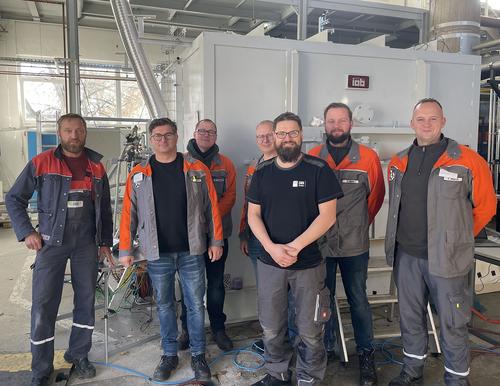
When employees of Mannesmannröhren-Werk GmbH a few months ago travelled to the DBI-Group (department gas utilization) in Freiberg, they brought some strategically important questions along with them: Can we reduce our CO2 emissions without having to scrap our existing production facilities? Can our existing heat treatment furnaces in Zeithain also be operated using hydrogen instead of natural gas? Are our facilities suitable for the transformation? The institute was assigned to conduct a study to examine these questions in depth. The scientific response can be summarized briefly as follows: The furnaces are indeed compatible with hydrogen. And this finding is all the more surprising when you consider that a large share of these furnaces date back to the year 1979. Thanks to regular maintenance and modernization, the plant has been optimized for sustainability over the decades and prepared and readied for the green transition.
But why did the tube factory have its furnaces inspected for hydrogen compatibility just now? Zeithain wants to be prepared for linking up to the hydrogen backbone network – regardless of whether this connection takes place as planned in 2029 or – as recently feared – is delayed by a few years after all. The prospect of a pilot electrolyzer located in the immediate vicinity of the plant also encouraged company officials to explore the topic of hydrogen in depth, with support from the scientific community.
“We want to actively keep pace with technological developments and make the right decisions for the future of our location in a timely manner,” as Michél Ifland, Managing Director of Mannesmannröhren-Werk GmbH in Zeithain, stated, underlining his company’s commitment.
Decarbonization does not come to a halt at the blast furnace
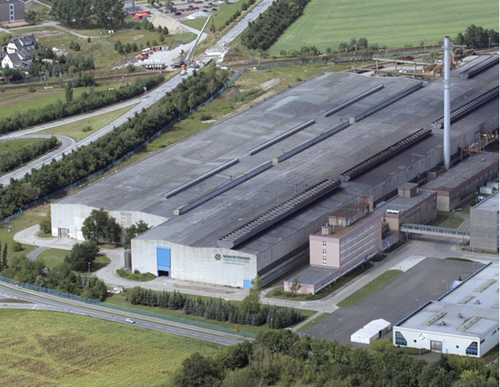
Zeithain is not manufacturing steel, and Zeithain does not melt anything. The facility receives round tubes – known as semi-finished products – as raw material. Employees in Saxony heat the steel, roll it, and use it to manufacture small-diameter seamless steel tubes. The cold-drawing plants of the Mannesmann Precision Tubes Group process these into precision tubes, such as those used for powertrains in the automotive industry. Five large types of industrial furnaces (see box) keep the manufacturing process running in Zeithain.
To date, they have been opting for natural gas to heat the steel, which results in emitting about 21,000 metric tons of CO2 per year. Based on the 9.364 million metric tons of CO2 equivalents that the Group reports as direct Scope 1 greenhouse gas emissions in 2025, this would appear to be negligible. But in Zeithain, people don't see this as a reason to sit back and relax. “Whoever, when hearing the word ‘steel,’ only thinks of the transformation of blast furnaces is missing the bigger picture,” as Jens Imhof, Energy and Environmental Management Officer stated. “When it comes to decarbonizing industry, we mustn’t focus exclusively on steel production; we also need to keep an eye on CO2 emissions arising in the processing further down the line.” In other words: While major transformation programs such as SALCOS® may be the main focus, our commitment does not stop there. All the companies within in the Group must do their part to gradually decarbonize every step of the process. “In Zeithain, we are committed to this responsibility: We are supporting Salzgitter AG's strategy.”
From a steel ingot to a finished pipe: 5 furnaces in operation
In Zeithain, five types of furnaces are involved in producing seamless, hot-rolled steel pipes.
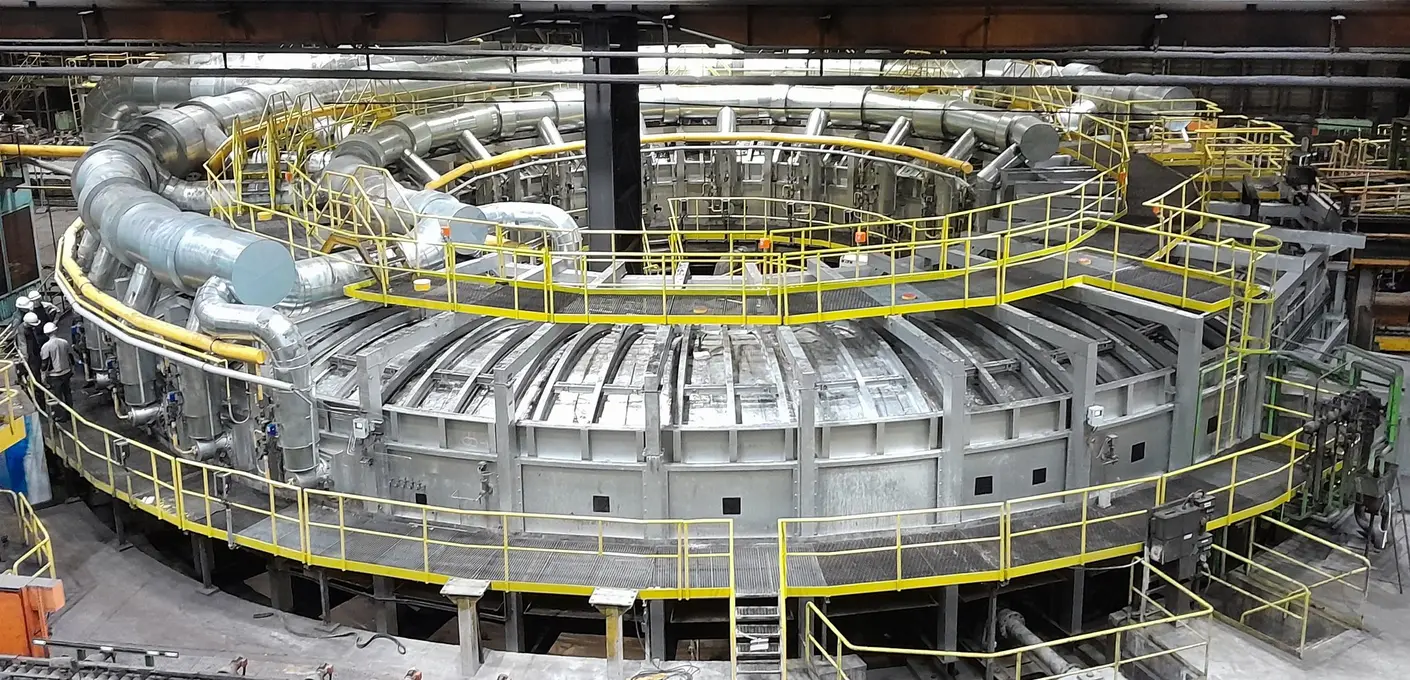
- The rotary hearth furnace transforms a cold steel ingot into a uniformly heated, plastically deformable blank by heating it to 1,300 degrees. The stove's name comes from the rotating ring or disc-shaped burner. As a result, the blocks move continuously through various temperature zones – such as preheating, heating, and thorough heating.
- The pusher-beam furnace, a reheating furnace, brings the semi-finished tube stock up to the correct temperature for the next forming step.
Rotary hearth furnaces and pusher-beam furnaces are the two types of furnaces that consume the most energy. Two additional furnaces do not heat the steel itself, but the tools.
- The mandrel preheating furnace heats the mandrels used to manufacture the loupes. The mandrel is inserted into the tube and determines the tube's inner diameter and wall thickness during rolling. The tool must be heated in order to prevent cracks in the tube.
- The mandrel stabilization furnace ensures that the mandrels heat up evenly and do not bend. This helps prevent structural defects during subsequent rolling. Stabilization is a critical step in the process given that some of the rods are very long and are subjected to severe thermomechanical stresses.
Another furnace is used for the heat treatment of the tubes. In Zeithain, this primarily involves those tubes that do not end up at the group's drawing mills for further processing but are shipped directly to customers.
- The continuous annealing furnace uses targeted annealing to eliminate the stresses that arise during hot forming. The furnace also refines the grain size of the steel and ensures a uniform metallurgical structure along the entire length of the tube.

A plant with two options: hydrogen and electricity
Part of this responsibility is ensuring that the plant approaches the transformation with an open mind in terms of technology. After all, the hydrogen route is just one option on the path towards low-carbon steel products. In theory, various alternative energy sources could be used for each of the furnaces – such as hydrogen and electrification, for example, by way of induction. “Studies like the one conducted with DBI Freiberg help us develop the most environmentally expedient and economically efficient strategies,” says Michél Ifland. Three furnaces were shortlisted for the hydrogen study, while a fourth is being evaluated in parallel for its electrification potential.
How does hydrogen burn compared to natural gas?
But why do facilities need to be assessed and examined in detail if they are to switch from natural gas to hydrogen? Not all gas is the same. Hydrogen is the lightest element and therefore burns differently than natural gas. When it is burned, significantly more water vapor is produced in the exhaust gas. And because hydrogen molecules can escape more easily through even the tiniest leaks, it is essential to thoroughly check whether seals, valves, and lines remain leak-tight also under these conditions.
The rotary hearth furnaces, mandrel bar preheating furnaces, and continuous furnaces were tested on the hydrogen test bench in Freiberg. They perform a variety of tasks at the plant – from preheating to the final annealing of the pipes.
Tripartite research design
Conducting the infrastructure inspection, they examined all components that come into contact with gas – from tubes and seals to safety valves – and identified necessary adjustments to the gas supply, control, and safety systems.
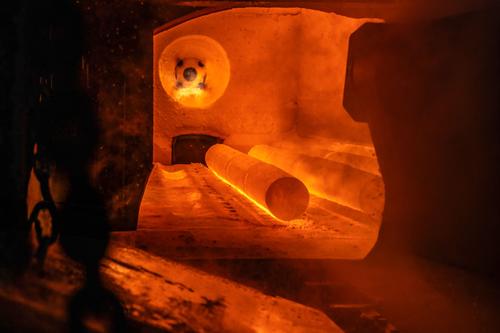
In performing the heating test, the testing experts at the Freiberg pilot plant heated a steel sample to 1,300 °C using both natural gas and hydrogen – a temperature corresponding to what is required in the production process. The focus here was on whether the temperature control and material properties change, and what effects hydrogen has on the heating process.
Conducting the burner test, they then operated an actual burner from the continuous annealing furnace using various mixture ratios of natural gas and hydrogen—with the hydrogen content ranging from 0 to 100 percent. In this field test, under controlled conditions, the researchers examined whether a type of burner used in Zeithain is in fact suitable for hydrogen.

Hydrogen embrittlement: no signs in the heating test
“The most important finding for us is that the quality of the steel remains identical, regardless of whether we heat it with natural gas or hydrogen,” says Imhof, who eagerly followed the test procedures on site. The steel exhibited no differences in terms of hardness or microstructure. Concerns that embrittlement might occur due to hydrogen molecules penetrating the steel surface and remaining as impurities during cooling proved to be unfounded. “This can occur in particular when the material is exposed to high pressure or significant pressure fluctuations in a hydrogen-rich atmosphere, combined with high temperatures,” said Imhof. “As we have been able to demonstrate, however, this does not play a role in our heating processes.”
This is a decisive insight: This is because hydrogen-induced embrittlement is a major concern, as it can cause metals to lose their toughness when atomic hydrogen particles become incorporated into the metal's crystal lattice. Under mechanical stress, sudden brittle fractures may occur. “The research findings, however, show that there is no compromise in the quality of the steel.”
How the existing furnaces become hydrogen-compatible
This scenario allows the actual production processes to remain unchanged. It won't be possible to do without some adjustments, however, if hydrogen replaces natural gas in the future: Existing burners use the electrical conductivity of the flame to detect whether it is burning. However, a hydrogen flame burns differently and produces a weaker signal – so the monitoring must be adjusted. In addition, condensation may form in cooler areas of the oven. “But all of this can be managed with technical solutions,” says energy expert Imhof. The necessary changes are minor. “This is indeed the result we were hoping for: we can continue to use our furnaces and our facilities and will not have to build new ones.”
Equipped and ready for the Future
There are still some uncertainties facing the current findings. It is not yet clear when the connection to the hydrogen core network will be put in place or how the price of hydrogen will develop. It also remains unclear as to when a substation currently under construction will be able to supply enough electricity for the plant to “switch over” some of the furnaces to induction. According to Imhof, one thing is certain: customers are already asking for low-carbon steel, and he advises exploring all options in a timely manner and evaluating all viable approaches in terms of their technical feasibility, environmental impact, and economic efficiency. Proceeding in this manner, we can prepare and equip for future developments. In Zeithain, they've already given the future a try. Now all that's left is for the infrastructure to catch up.
Discover similar posts
Hydrogen Supply Agreement: Negotiations in terra incognita
10,000 tons of green hydrogen per year: What sounds like the conclusion of a standard supply agreement actually marked a pioneering achievement involving Salzgitter AG and its partner EWE. How to negotiate a contract without any existing templates – and what this entails for the steel industry.
Read post
The invisible grid of the energy transition
A significant share of Germany's ongoing industrial transformation is taking place underground: The conversion, expansion and new construction of the pipeline networks for thermal energy, water and hydrogen is the largest and probably most diffuse construction site in the entire country. A Herculean task in which steel pipes are putting down the technological foundation.
Read postThe address of this article has been copied to your clipboard.