
From pneumatic tubes to a 5G campus
May 13, 2026 | Reading time: 14 minutes
Salzgitter Digital Solutions GmbH is setting up the Salzgitter Group’s own 5G campus networks. It is digitalizing industrial buildings, cranes, and entire plants. And soon, an inland port as well.
On the premises of Salzgitter Flachstahl GmbH, steel capsules speed through tubes at seven meters per second. They contain material samples that need to be sent to the lab for quality assurance. Until now, there has been no suitable digital replacement for pneumatic tubes, an analog technology that has worked reliably for decades.
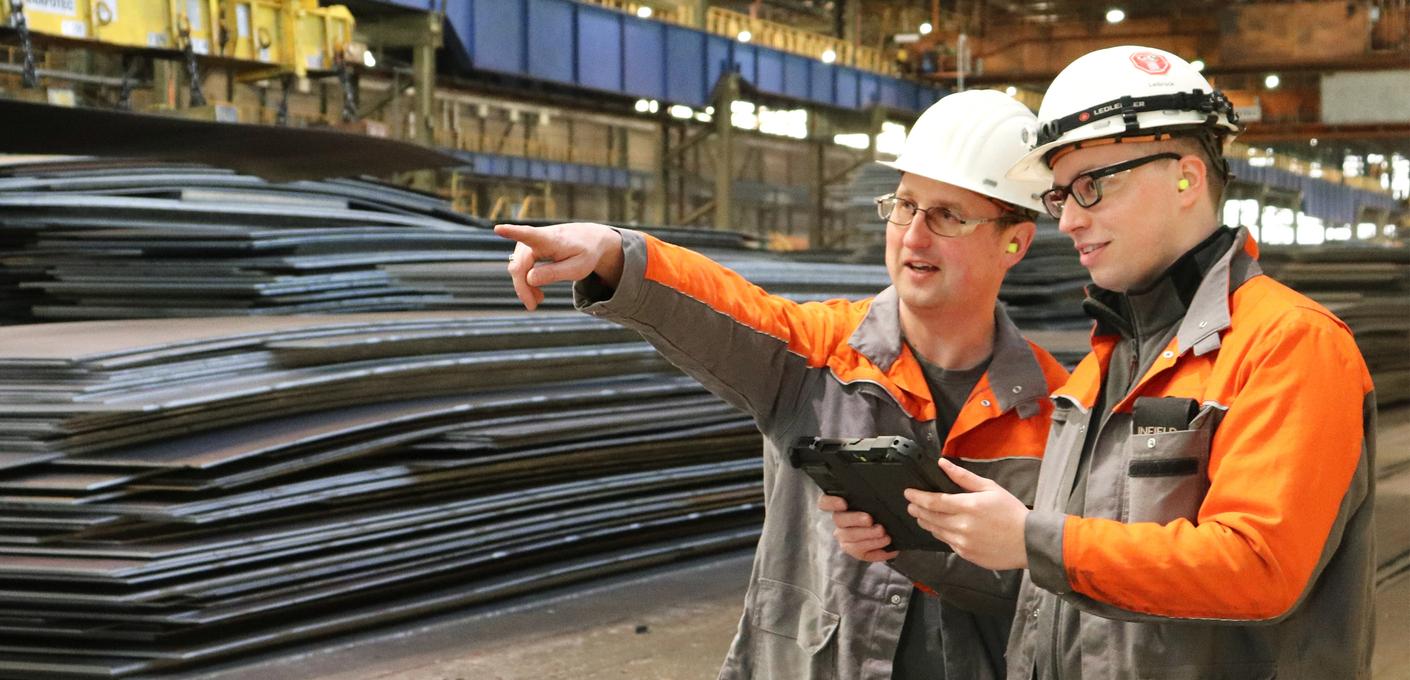
Transmitting digital data within a plant is a different story: At Ilsenburger Grobblech GmbH, another company in the Salzgitter Group, cranes transmit process data to control systems, cameras provide real-time images for remote control, and employees record warehouse data on mobile tablets. This requires bandwidth, low latency, and a connection that won’t drop out even in a steel factory building where temperatures reach up to 80 degrees Celsius. Wi-Fi reaches its limits in such environments—and the public cellular network is often insufficient on sprawling industrial sites.
Salzgitter Digital Solutions GmbH (SZDS), the Salzgitter Group’s central IT service provider, is therefore taking a new approach by setting up the Group’s own 5G campus networks. These are not just a vision of the future on PowerPoint slides, but a functioning infrastructure in active production facilities.
The handymen of SZDS
Christian Kühlen, Head of Industrial Communications at SZDS, is the person responsible. His department handles everything related to radio transmission and reception within the company—from telecommunications and radio remote controls to messaging technology. “You could say we’re the handymen of SZDS,” says Kühlen.

Salzgitter Digital Solutions has had 5G on its radar for years. The idea is to establish a dedicated cellular network for factory premises, with its own frequency, its own infrastructure, and full control over data and access. The 5G cellular communications standard provides stable connections even in harsh industrial environments. A campus network ensures independence from external providers’ network infrastructure. And it can transmit large amounts of data in real time—camera images, sensor data, warehouse management information—for which previous Wi-Fi or LTE connections in the industrial buildings were often not reliable enough.
Ilsenburg: where steel meets radio
Kühlen found the answer in Ilsenburg, at the feet of the Harz Mountains in Saxony-Anhalt, where Ilsenburger Grobblech GmbH manufactures heavy steel sheets under extreme conditions—the most demanding environment imaginable for radio technology. Together with its technology partner Cocus AG, SZDS initiated a proof of concept—a structured field test under real production conditions—at the end of 2025.
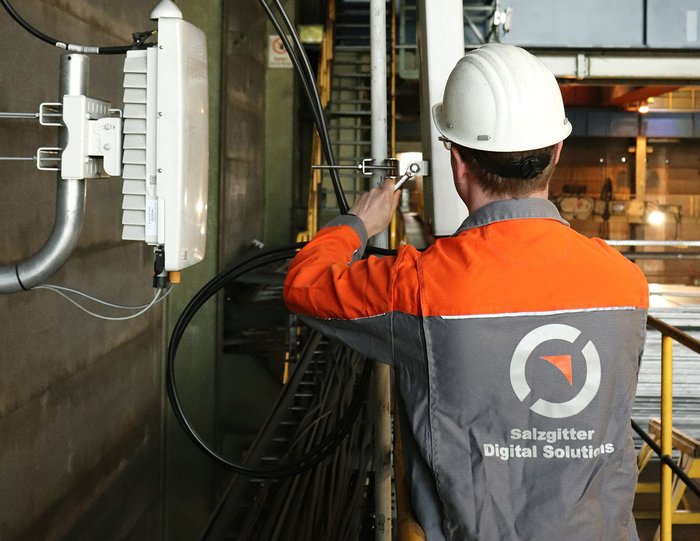
In the company’s shipping hall, which measures 350 by 70 meters, a single 5G radio unit now covers the entire area, with the signal even reaching into the neighboring hall. Previously, seven Wi-Fi access points were required for this. Four cranes moving sheets of metal from A to B operate entirely over the 5G network. Interruptions and data loss during transmission have decreased dramatically. “The system really works flawlessly,” says Kühlen. In another hall, employees use industrial tablets to enter sheet metal data directly into the process control system in real time—instead of jotting down information with pen and paper and later typing it into a desktop computer.
For the next phase of the project, a crane has been equipped with five high-resolution cameras, which will be controlled from a central control station. The low latency of the 5G network will make it possible for a single crane operator to monitor and control multiple cranes—a significant efficiency gain for the site. “When a crane breaks down, it’s not just annoying,” says Kühlen. “In the worst-case scenario, production comes to a standstill—and that costs a lot of money.”
What is a 5G campus network?
A 5G campus network is a private cellular network for a defined area—such as a factory site or a port. The German Federal Network Agency allocates the network exclusive frequencies for a period of ten years. Only devices with specially configured, device-specific SIM cards can access it—a personal smartphone cannot connect. The infrastructure comprises a core system (central control unit), radio units (transmitters), and 5G modems in the end devices. All data remains on the company premises.

Peine: from testing to contract
More money than a 5G campus network, in any case. SZDS funded most of the field test itself—at a time when the industry’s economic situation was not exactly conducive to investing in new technologies. Word quickly spread throughout the Group that the concept was working. Even before the proof of concept in Ilsenburg was officially completed, for example, Peiner Träger GmbH, also a subsidiary of the Salzgitter Group, came forward with a concrete order.
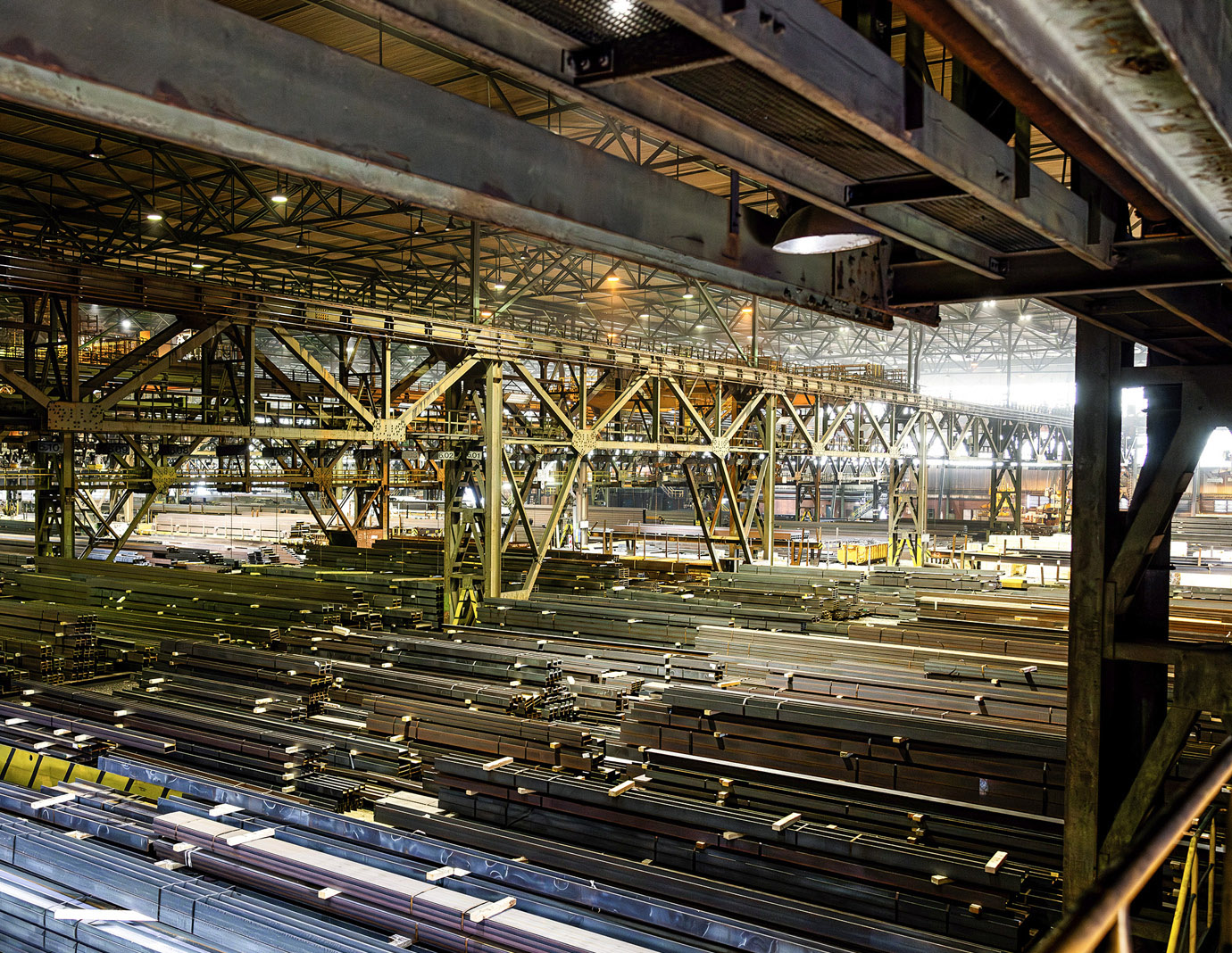
The challenge in Peine, Lower Saxony, is different from that in Ilsenburg: a sprawling, fragmented factory site with a new truck depot, where mobile devices must function reliably for warehouse management. The public cellular signal is too weak on the premises, and Wi-Fi in open areas is not an economically viable option. The solution: six 5G radio units, distributed across indoor and outdoor areas, tailored to the site’s layout. The team takes care to ensure that the signal does not radiate into adjacent residential areas.
Looking ahead, Peiner Träger GmbH plans to use cameras to automatically track steel slabs. “It’s hard to believe, but even something as large as a slab of metal can go missing,” says Kühlen. Cameras installed at designated points could capture the stamped serial numbers and track each slab’s path through the plant. “We at SZDS have offered to make this plan a reality, in part by utilizing our 5G network.”
A grand vision for the port in Beddingen
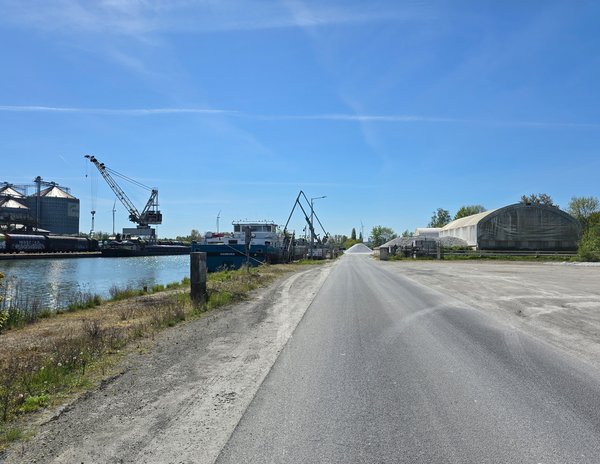
SZDS is pursuing its most ambitious plan in collaboration with Verkehrsbetriebe Peine-Salzgitter (VPS) at the port in Salzgitter-Beddingen. The company has applied for funding for an extensive 5G-based digitalization project from the German government’s DigiTest program, which supports digital test beds in ports.
The plans in Beddingen go far beyond mere network coverage. At the heart of the project is a digital port management platform designed to replace the largely analog operations of the past with real-time, networked processes. Bulk materials will also be automatically identified and measured using LiDAR lasers and cameras. Currently, quantities are estimated by eye, which regularly leads to significant discrepancies. 5G wireless technology can also enable port cranes to be remotely controlled from a central control station, as the low latency allows camera images to be transmitted smoothly. And a camera-based waterway tracking system will monitor shipping in the Salzgitter branch canal in real time.
“In the future, we can also envision operating our inland vessel, the ‘Blue Marlin,’ remotely or even semi-autonomously,” says Kühlen. “The necessary SEAFAR technology already exists—but that’s still a long way off.” A total of 15 radio units are planned for the port and the branch canal.
Salzgitter-Beddingen port
The port in Salzgitter-Beddingen is the busiest inland port in Lower Saxony. Up to 2.5 million tons of goods are handled here each year—ranging from steel and scrap metal to agricultural and petroleum products. As a trimodal logistics hub, the port connects waterways, rail, and road. It is operated by Verkehrsbetriebe Peine-Salzgitter (VPS), a subsidiary of Salzgitter AG, which maintains its own 155-kilometer rail network.
Modular, scalable, and needs-based
The real star of the SZDS approach is not the technology, but the scaling model. The central core system—essentially the brain of the 5G network—will be operated at the SZDS data center in Salzgitter. “We are a group and we have a data center,” says Kühlen. “It would stand to reason to make a one-time, centralized purchase of the expensive core system for a campus or a connected area and then to make it available to all the companies located there.” From the core, additional locations could be connected via fiber optic cables without each subsidiary having to build its own core infrastructure. The costs would be shared among all participating companies, and the initial and ongoing costs would be significantly lower for each additional location.
Kühlen is following a pragmatic principle here: a 5G campus network is always set up where a specific use case justifies its implementation—not as a one-size-fits-all solution for an entire plant at once, but rather in a modular, scalable manner that is tailored to actual needs. The group companies receive everything from a single source: SZDS plans the infrastructure, procures and installs the hardware, configures the network, integrates end devices and applications, and handles day-to-day operations. “As a rule, we do everything,” says Kühlen. “Either on our own or with partners.” The technology works, and the results speak for themselves—with each new location, the network grows, and so does the Group’s expertise.
The address of this article has been copied to your clipboard.