
“A vote of confidence that we must live up to”
October 21, 2026 | Reading time: 17 minutes
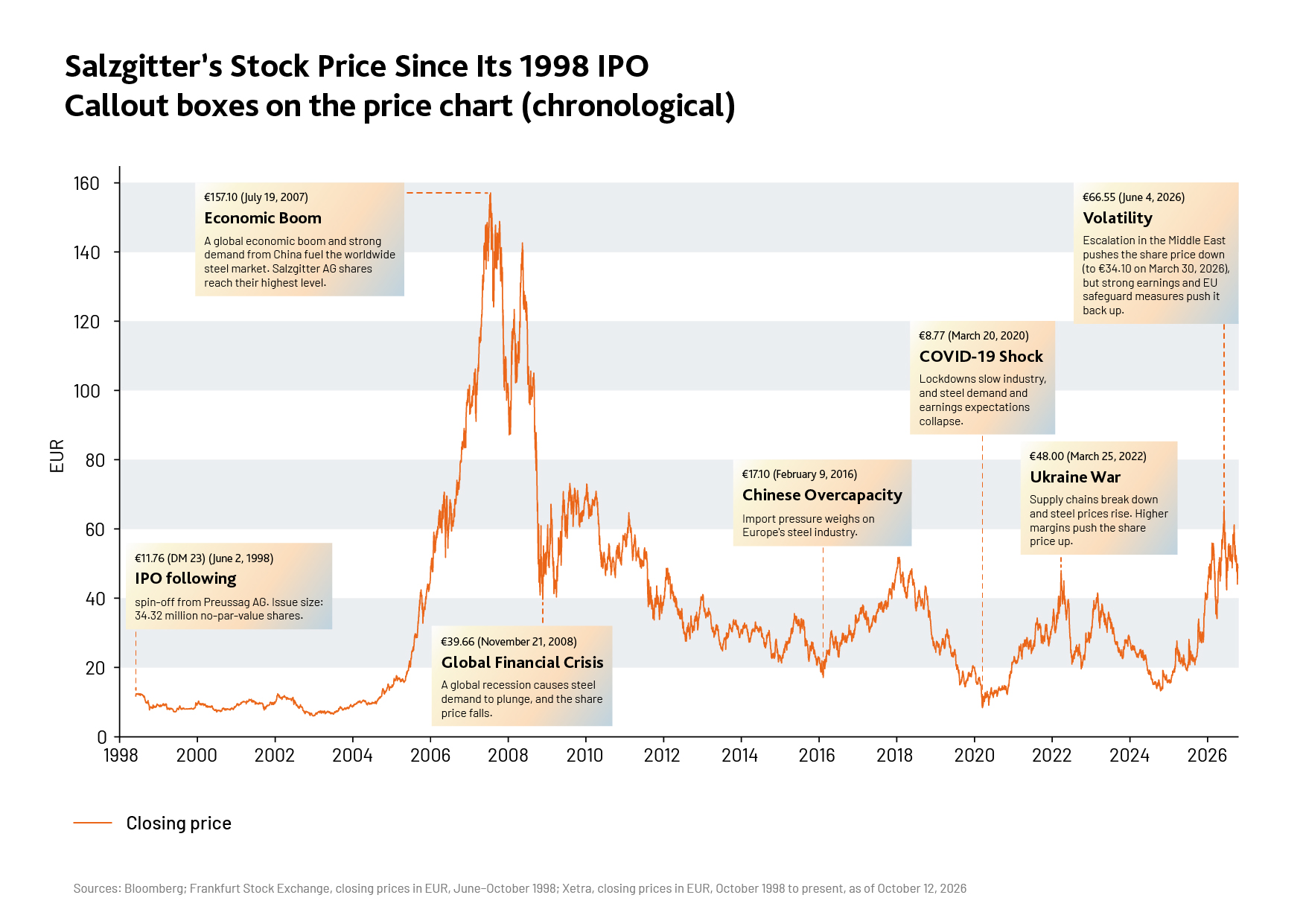
Surging upwards by around 250 percent in 24 months and heading toward a 15-year high: Salzgitter AG’s stock is one of the most notable on the MDAX. Markus Heidler, Head of Investor Relations at Salzgitter AG, on capital market expectations, P28, SALCOS®, HKM, and the Group’s long-term performance.
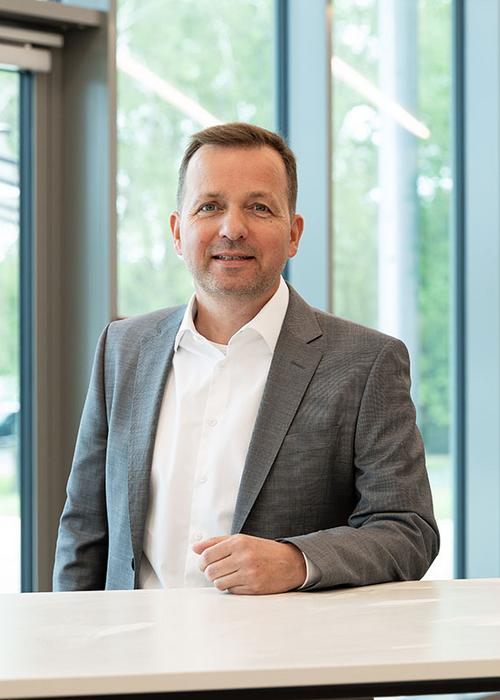
The interview with Markus Heidler took place in early September 2026.
Mr. Heidler, the Salzgitter stock has climbed by more than 250 percent over the past 24 months and just recently reached a 15-year high. As an IR manager, you must be bursting with pride, right?
Of course, I am delighted about these developments – and I am also happy on a personal level. I joined Salzgitter AG in April 2008, right in the middle of the steel boom at that time. Back then, the share price stood at 111 euros. Shortly thereafter, Salzgitter stock was temporarily included in the DAX. Since then, I have experienced, among other things, the financial crisis, China’s overcapacities and the COVID-19 pandemic – with share prices plunging to the single-digit euro range. That’s why, for me, the current price movement isn’t just a number on the screen – it’s also linked to many personal memories of very different market phases. And it reminds me of how much patience our shareholders have shown over the past few years.
What insights have you gained from these fluctuations?
The most important lesson I have learned from nearly two decades of working in the capital markets is this: You shouldn’t attach undue significance to short-term price fluctuations or individual market phases. Over the long term, trust is built when a company explains its strategy clearly, delivers reliably, and addresses critical questions openly.
How well did Salzgitter AG succeed in this?
European steel and Salzgitter AG are now viewed in a more differentiated way. Enhanced European trade defense measures, the Carbon Border Adjustment Mechanism (CBAM), our transformation with SALCOS®, and the progress we achieved through our P28 profit improvement program are gaining increasing recognition. For us, the stock’s performance is therefore above all a vote of confidence that we must live up to, both in operational and strategical terms.
The pre-tax result for 2025 was minus 28 million euros. How do you explain this apparent contradiction with the stock’s strong rally?
“Back to Black” was our core message for financial year 2025: The reported pre-tax income included a negative valuation effect from the exchangeable bond issued in October 2025. Adjusted for this non-operating effect, our so-called EBT VX – meaning earnings before taxes excluding valuation effects from the exchangeable bond – came in at plus 2 million euros – in other words, reflecting that we had reached the break-even point. P28 has already made a significant contribution in this respect. The fact that we were able to raise our forecast for EBT VX to €325 million–425 million for the current year underscores this trend. Investors evaluate not only the results of a single financial year, but above all the progress made toward sustainably improving operating performance.
Many analysts have upgraded their ratings on Salzgitter stock in recent months. At the same time, the European steel market is once again playing a more significant role in the valuation models. Is the recovery in steel prices the key driver of stock prices?
No, rising steel prices are a tailwind, but they are not the only factor here. In my view, what has changed most of all is the perception of the European steel industry. Supply security, industrial resilience, and a level playing field are more important today than they were just a few years ago. The fact that no analyst currently has a “Sell” rating on Salzgitter stock reflects this shift in perspective. The outlook for European steel companies is generally viewed more positively today – not only because of steel prices, but also due to their strategic significance to Europe as an industrial base.
What does Investor Relations do?
Investor Relations ensures transparent communication between the company and its capital market stakeholders, particularly investors, analysts, and rating agencies. This unit focuses on business development, strategy, and opportunities and risks, while also feeding capital market expectations back into the company.
At Salzgitter AG, a team of nine colleagues combines financial reporting and in-depth engagement with investors and analysts with relevant ESG issues. Today, financial performance, transformation, and sustainability are increasingly intertwined. The role of the IR department is to provide a clear and transparent overall picture. After all, the capital markets can only value what they understand.

The participation in Aurubis alone contributed 193 million euros to pre-tax earnings in the first half of 2026. How do you convey to investors that Salzgitter AG’s operating business is attractive even without Aurubis?
The participating interest in Aurubis is an extremely valuable part of our portfolio and makes a strong contribution to our earnings. However, the contribution to earnings should not be equated with the ongoing cash flow contribution from the investment to Salzgitter AG. The latter consists exclusively of dividend payments. That is why the capital markets keep a very close eye on the performance of our business segments. In the first half of 2026, the Steel Production, Trading, and Technology segments showed significant improvements.
The state of Lower Saxony holds a 27.9 percent stake in Salzgitter AG, while the construction group GP Günter Papenburg holds just under 10 percent. Does this shareholder structure act as an anchor of stability or as a valuation discount?
I would definitely call it an anchor of stability. The State of Lower Saxony has been a shareholder of Salzgitter AG since its initial public offering and has supported the company through various market phases. This long-term focus provides stability and predictability – especially in times of far-reaching transformation. Our role in Investor Relations is to combine the advantages of a stable shareholder base with good market liquidity for our stock and a broad international investor base.
At the end of April, you began selling treasury shares to increase availability. On the day of the announcement, the stock price dropped by 7.5 percent. Was that decision a mistake?
No, even in hindsight, that was the right move. We were responding to repeated feedback from investors: Only a relatively small proportion of Salzgitter’s shares were available for trading on the stock market. This was due, on the one hand, to the holdings of our anchor shareholders and, on the other hand, to the fact that Salzgitter AG held approximately 10 percent of its share capital in the form of treasury shares. These shares were not available for trading on the stock exchange and were not part of the free float. For some institutional investors, this meant the stock was only a limited investment option. We made a conscious decision to release the shares into the market gradually and in a manner that would minimize impact on the share price, in order to incur as little negative effect on the market as possible. Today, the stock is more liquid and easier for investors to trade.
SALCOS® is the largest investment in the history of Salzgitter AG. Why are you convinced that this project will pay off for the company’s shareholders?
An investment of this magnitude naturally involves risks. In my view, however, the greater danger would have been failing to take an active role in shaping the transformation ourselves. With SALCOS®, we are creating the conditions to produce steel with significantly lower CO₂ emissions, limit regulatory burdens, and help our customers in their decarbonization efforts. At the same time, we are ensuring the long-term viability of our location. Funding for the first phase has been secured and stems from public subsidies and a substantial contribution from Salzgitter AG. The modular approach of SALCOS® allows us to implement the transformation step by step and take technological and market developments into account. The key to economic success will be how well technological implementation, customer demand, and competitiveness all come together.
For years, many investors have doubted that “green steel” could be a profitable venture. Is there a different view on this today?
The discussion today is more nuanced. In the past, decarbonization was primarily viewed as a cost and a risk factor. Today, investors are increasingly asking how companies are implementing this transformation and what competitive position this results in. Our customers are pursuing their own decarbonization goals and need low-carbon steel products to achieve them. The market will show whether – and how quickly – this leads to additional opportunities for returns. We are already laying the groundwork to participate in this market.
P28 is already delivering measurable contributions to earnings. Is the program now a more compelling investment opportunity than SALCOS®?
P28 and SALCOS® are pursuing different objectives and are designed for different time horizons. Today, P28 is improving our earnings, cash flow, and resilience. SALCOS® is laying the groundwork for us to produce steel competitively over the long term. One strengthens our operational performance, while the other ensures our long-term viability. We are achieving success through a combination of both.
In addition to P28 and SALCOS®, the integration of the HKM steelworks in Duisburg is now another strategic component of your realignment. thyssenkrupp Steel and Vallourec are exiting the company, and Salzgitter AG is taking over full ownership. What does Salzgitter AG see in HKM that others don’t?
For us, the key question is not what others may not see, but rather what strategic significance HKM holds for Salzgitter AG. HKM is an important part of our steel business. Even an orderly winding down of operations would have entailed significant economic burdens. So, there was no risk-free option. We therefore opted for the solution that opens up strategic options and entrepreneurial flexibility for us. And now it’s crucial to take full advantage of these opportunities. The capital markets will judge us on how well we do that.
A steel company that is simultaneously undertaking a multibillion-euro transformation program, cutting costs, acquiring HKM, and increasing its free float: Aren’t you overwhelming the capital markets with too many narratives?
The topics vary, but they all follow a common plan: We want to sustainably enhance the competitiveness and value of Salzgitter AG. One of Investor Relations’ key tasks is to make this connection clear and to translate complex developments into a coherent equity story. The capital markets must be able to recognize how P28, SALCOS®, HKM, and the improvement in the free float collectively contribute to long-term value appreciation.
The appeal of Salzgitter stock therefore stems less from a high current dividend than from its industrial fundamentals and future appreciation. A dividend of 0.20 euros per share, based on a share price of 50 euros, corresponds to a yield of less than 0.5 percent. Why should a dividend-focused investor buy this stock?
Investors who are primarily looking for the highest possible dividend yield will certainly find other stocks on the market. Despite its reliable dividend track record – with the well-known exception during the COVID-19 pandemic – Salzgitter AG is not a traditional dividend stock. Our equity story is based more on industrial fundamentals, the transformation of a leading European steel manufacturer, the improvement of our profitability, and an attractive value profile. For many investors, Salzgitter stock is also one of the few ways to specifically benefit from positive developments in the European steel industry.
Let’s be honest: Is the Salzgitter stock fairly valued at its current level, or do you see upside potential for further gains?
This is up to the investors to decide. Personally, however, I am pleased that the capital markets are now recognizing many of the advances we have been working on in recent years. At the same time, in my nearly two decades at Salzgitter AG, I have learned that you should never read too much into stock prices. What really matters is not where the stock stands today, but whether we achieve our operational and strategic goals. If we can do that, I am confident.
Discover similar posts
Back to black: Salzgitter Group stabilizes earnings
A weak economy, high energy prices, and global overcapacity: In this interview, CFO Birgit Potrafki explains how Salzgitter AG overcame adverse conditions to deliver stable earnings in 2025, the role played by the P28 earnings improvement program and the exchangeable bond, and why she is cautiously optimistic about the new financial year.
Read interview
"You can always do just a little bit better"
Optimizing in-house processes, scaling solutions and listening as closely as possible to customers: How the new "Operational Excellence" unit at subsidiary Salzgitter Flachstahl GmbH is driving Salzgitter AG's performance forward.
Read postThe address of this article has been copied to your clipboard.