
June 30, 2026 | Reading time: 17 minutes
Quotas down, tariffs up, curbing imports? What the new safeguard measure means for the European steel industry. Our expert Helge Langheim summarizes the key facts.
1. Competitive pressure is particularly extreme in the steel industry
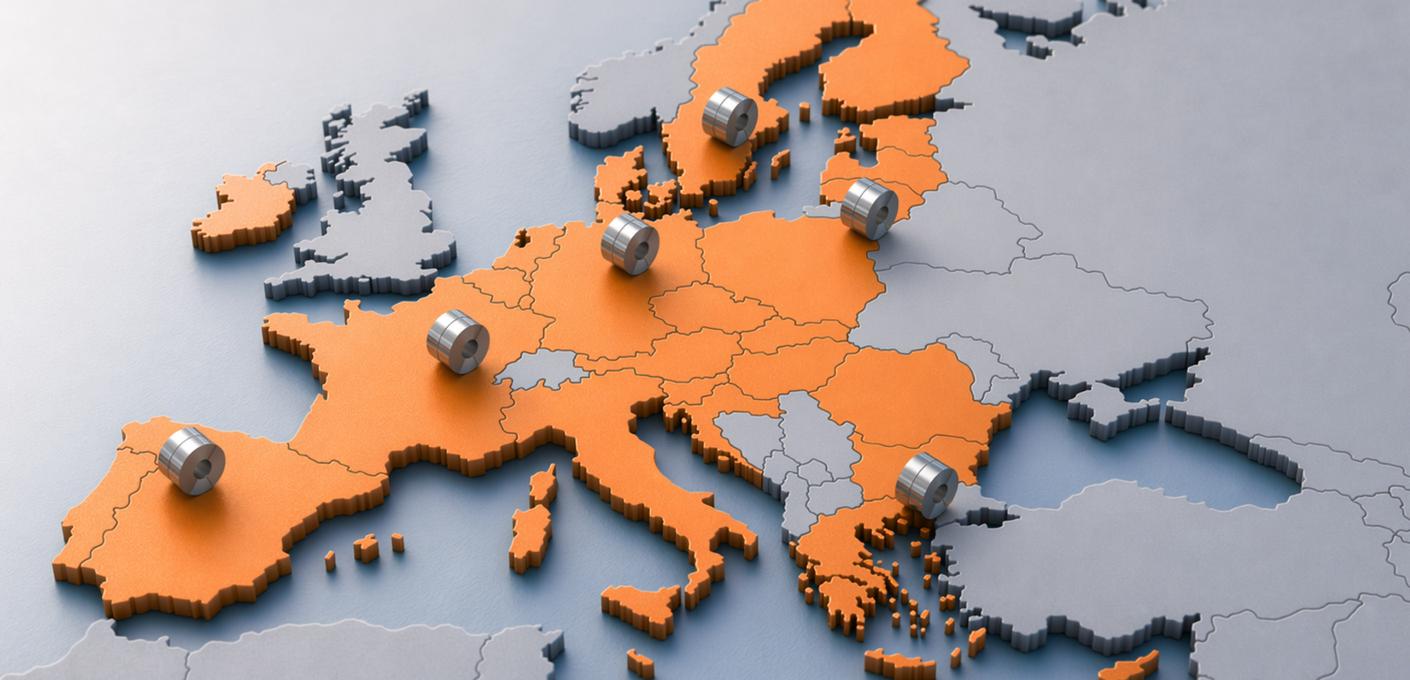
The steel industry has been suffering from massive overcapacities for more than a decade. According to the OECD, this volume is expected to rise from 640 million metric tons today to about 745 million metric tons by the year 2027 – which will further exacerbate global overcapacity. Asian economies account for 58% of the new capacities coming on stream. Their local markets have long been unable to absorb the additional volumes produced. Therefore, steel – which is often subsidized – has been flooding the EU market. As a result, the European steel industry lost more than 100,000 jobs and 65 million metric tons of capacity since the year 2008. Considering this situation, the European Commission has decided to develop a new safeguard measure specifically designed to counter the effects of global overcapacity. The goal is to sustainably preserve European steel production capacity and to promote the transformation – given that the domestic steel industry is of crucial strategic importance to the European economy, defense capabilities, and resilient supply chains. The European Parliament and the Council adopted the “Regulation on mitigating the negative trade-related effects of global overcapacity on the Union steel market” in May and June 2026, which is set to take effect on July 1, 2026.
As Helge Langheim comments: “With this new trade defense instrument, European lawmakers have recognized that the global overcapacity in the steel market is not a temporary problem impacting on individual countries – but rather a structural crisis that threatens the very existence of the European steel industry.”

2. New protective instrument: Stricter quotas for the value chain
In the past, the EU has imposed anti-dumping, anti-subsidy, and safeguard measures to protect the EU market. However, these measures were not sufficient to address the structural consequences of the overcapacity crisis. The safeguards introduced in 2018 in response to the first Trump tariffs will expire on June 30 2026. Due to numerous compromises, they no longer provided any protection. Given this situation, the EU has decided to develop a new, strengthened protective measure to replace the safeguards.
Like the safeguards, the new instrument will operate as a tariff-rate quota system. Above the defined quotas, a 50% tariff will apply – up from the previous 25%. A key difference from the old system is that the duty-free quotas are being reduced by half, making them significantly more effective than formerly. Another new feature is that additional steel-processing products can be included in the instrument, thereby mapping the entire value chain.
Helge Langheim outlines: "The new instrument reflects the urgently needed paradigm shift in EU trade policy. "A shift away from piecemeal and highly resource-intensive penalties for individual violations of commercial law toward a structural measure that focuses firmly on value chains, resilience, and climate protection."
3. The new safeguard measure differs significantly from U.S. trade policy
In the United States, 50% tariff applies starting with the first metric ton. Under the new safeguard measure, however, a total quota of 18.3 million metric tons of steel may be imported into the EU duty-free – amounting to a reduction of just under 50 percent. A 50 percent tariff applies to imports outside the quotas, which previously stood at 25 percent. In addition, importers must maintain a so-called “Melt & Pour” proof of origin; Information regarding the country of melting and pouring will be mandatory in the future. The aim is to prevent, for example, Chinese steel from entering the EU by way of third countries. As a result, capacity utilization in the EU steel industry is likely to rise again to a satisfactory level and also support prices, without leading to absurd price spikes for steel users, as has happened in the United States.
Helge Langheim goes on to explain: "The new quotas will result in significant cuts for major importing countries such as China, Vietnam, Turkey, and India." The higher tariff rate of 50% also acts as a much stronger deterrent and can no longer be absorbed as easily as was previously the case. “All in all, it is a very balanced measure that takes the interests of both producers and users equally into account.”
4. The new protective measures are not anti-dumping duties
Equating the two is a widespread misconception: The new protective measures primarily impact on quantity rather than price and are intended to ensure market stability. Anti-dumping and anti-subsidy duties are fundamentally different instruments. Anti-dumping duties are intended to counteract unfair price competition from a specific country and product; their effects are highly targeted and involve complex procedures.
Helge Langheim: "The new protective measures are much better suited to addressing excess capacity. Anti-dumping duties may have a short-term impact on a specific country, but they do not solve the problem. As soon as imports from a country are blocked by tariffs, importers turn to other countries, allowing the dumped goods to continue flooding the market by way of new routes. For this reason, both instruments should be viewed as complementary; after all, dumping can still occur even under the new protective measures. “We must continue to combat this in a targeted manner.”
5. The new instrument does not cover all steel products
The safeguard mechanism initially applies to 28 product groups, including, for example, flat steel, heavy plate, and beams, for which the share of imports has so far ranged from 25 to 35 percent. Semi-finished products such as slabs, on the other hand, have not yet been included. There is also a lack of protection for products at the first stage of the value chain: steel structures, tanks, wind turbine towers, and components.
Helge Langheim: "This definitely causes problems for our customers: Companies processing European steel into components are in direct competition with finished imports from China, which are not subject to customs duties. The problem of overcapacity not only exists in steel production but also in steel processing and must therefore be addressed as well. "An extension of the protective measure to value-added stages related to steel has already been appropriately initiated – and must be implemented in the coming months following the initial reviews – and the same applies likewise to the first stage of value creation, the production of slabs and billets."
6. CBAM and the new protective measures complement each other perfectly
CBAM stands for “Carbon Border Adjustment Mechanism”. This regulation is known in this country as the “CO2-Border Adjustment Mechanism.” With this instrument, the EU aims to create a level playing field for climate-friendly industries in the EU and support its decarbonization strategy. Starting as from January 1, 2026, steel importers must expect CO2 costs of approximately 50 to 60 euros per metric ton. This is intended to ensure a level playing field, at least in part, because the European steel industry is also tasked with assuming CO2 costs by way of emissions trading. The CBAM and the new safeguard instrument are interlinked and work in a complementary manner. Countries such as China, South Korea, and Indonesia, as traditional exporting nations, are allocated higher quotas through the new mechanisms, but must bear higher CBAM costs due to their CO2-intensive blast furnace production. Countries such as the Gulf states, which already have lower CO2 emissions due to cheap natural gas, will benefit from the CBAM – but will face lower import quotas under the new protective measures given that they have supplied relatively low volumes so far.
Helge Langheim: "This prevents one instrument from undermining the other. Nevertheless, there are still many challenges and risks regarding how these systems can be circumvented. The European Commission must continue to make improvements in this area. "Unfortunately, there are no limits to creativity here."
7. The new instrument ensures capacity utilization in Europe
The new protective measures are intended to ensure sustainable capacity utilization in the European steel industry and stable prices. The goal: long-term planning certainty that will make it possible to finance the green transformation, which will cost billions. Salzgitter AG is already well underway in its transformation toward virtually CO2-free steel production with SALCOS® – Salzgitter Low CO2 Steelmaking.
Helge Langheim: "Thanks to the new safeguard mechanism, steel manufacturers such as Salzgitter AG can better utilize capacity at their own plants, and what is more, we can shift our product portfolios toward products with higher margins." We very much welcome the fact that policymakers in Brussels and Berlin now intend to use their trade instruments to ensure the long-term economic viability of the steel industry. "This is tailwind for our SALCOS® transformation program."
8. The import restrictions represent a paradigm shift
The EU's import restrictions are meeting with protests in third countries. China accuses the EU of protectionism and has already threatened to take retaliatory measures. In countries outside Europe, many had apparently hoped for less stringent EU protective measures. After all, EU trade policy has traditionally been geared toward free trade and export-oriented growth – which is changing right now. In light of the flood of cheap imports from China, several EU countries are now pushing to further strengthen trade defense measures and extend them to other industrial sectors as well. Otherwise, they fear, imports could threaten entire industries and sectors in the EU.
As Helge Langheim outlines: "The observation that geostrategically oriented economic policies – including those of China – pose a structural problem for Western economies was already articulated in the United States during the Obama administration." It took Europe nearly a decade to reach similar conclusions – but it is now taking decisive action with the EU’s steel import restrictions. “We should stand firm on this position, also in the face of all opposition.”
9. Key markets for low-CO2 steel complement the EU's trade defense measures
With improved capacity utilization and stable prices, the steel industry sees itself as better equipped to invest in its sustainable transformation. Nevertheless, additional key markets for CO2-produced steel are needed to ensure demand for climate-friendly steel, which is more expensive to produce. The rationale: Until CO2-reduced raw materials become commercially viable on the market, companies need supporting measures for their transition efforts to ensure that their investments pay off.
Helge Langheim: "The CBAM and the new safeguard mechanisms create better conditions for the transformation of the steel industry." Further steps, however, are necessary. There are various options for green flagship markets, such as infrastructure projects such as the new hydrogen pipelines, for example, which should give preference to using low-CO2 European steel. “And in the automotive sector, manufacturers could lower their fleet CO2 limits by using low-emission steel.”
10. A green transition requires protection
The new protective instrument represents a turning point in industrial policy. This measure creates the economic foundation that allows European steel companies, such as Salzgitter AG, to invest in decarbonization rather than being forced out of the market by subsidized imports.
In concluding, Helge Langheim comments: “Salzgitter AG expressly welcomes this measure. We see a particular need for improvement in expanding into upstream and downstream stages of the value chain. We would like to thank the policy makers at both the German and European levels for recognizing the signs of the times and significantly upgrading protection against the effects of global steel overcapacity. The steel industry can serve as a model for other sectors here.”
Discover similar posts
CO₂ border adjustment – Driving green change in the steel industry
Since the beginning of 2026, CO₂ taxes have been levied on steel imports into the EU for the first time. Helge Langheim, Head of Foreign Trade Policy, Markets, and Statistics at Salzgitter AG, considers the CBAM to be necessary in creating climate protection incentives, not only for domestic producers but also for international competitors – despite criticism voiced concerning bureaucracy and potential loopholes.
Read interview
CBAM: Green steel needs fair rules
Too bureaucratic, too expensive, too protectionist opine the opponents – not consistent enough counter the advocates: Criticism of the CO₂ compensation mechanism CBAM, which has been in place since the beginning of 2026, continues unabated. Find out here why the instrument nevertheless remains indispensable for preventing carbon leakage and driving the decarbonization of industry forward.
Read postThe address of this article has been copied to your clipboard.