
Energy Procurement at Salzgitter AG: Keeping Step with Transformation
October 07, 2026 | Reading time: 14 minutes
Every 15 minutes, Ralph Schaper and his team are procuring electricity and gas for Salzgitter AG. A look behind the scenes at the energy center reveals how the group’s energy procurement works and how the transformation is changing Schaper’s work.
Key points at a glance:
- Ralph Schaper and his team procure electricity and natural gas for 15 Salzgitter AG locations.
- Of the 3 terawatt-hours of electricity that will be required in the future, 1.7 terawatt-hours have already been secured through long-term green power purchase agreements (PPAs).
- The PPA mix of solar and offshore wind is optimized based on environmental and economic criteria.
- The transformation will result in a radically transformed system – without blast furnaces or blast furnace off-gases, with green electricity and hydrogen as its foundations.

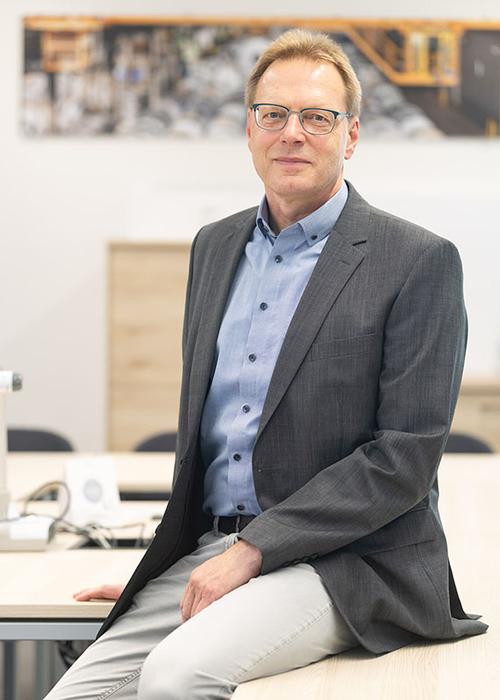
Multiple screens, real-time data from four different energy markets, and a department that is staffed around the clock: At Salzgitter AG’s energy control center, the team operates on a 15-minute cycle. The clicks of computer mice and the clatter of keyboards mingle with voices on the phone. “We used to set an electricity rate once a year,” says Ralph Schaper. “Today, we procure energy by way of individual long-term contracts, as well as on futures, spot, intraday, and balancing energy markets, for every single quarter-hour of the year – and sometimes at extremely varying prices.”
Schaper has been at the helm of the energy division at Salzgitter Flachstahl for 24 years. Together with his team, he ensures that electricity, gas, and heat are available exactly when the blast furnace, rolling mill, or electric arc furnace at the subsidiary Peiner Träger GmbH need these energy inputs. Around the clock, at 15 locations. And as part of this transformation, direct reduction plants, electric arc furnaces, and electrolysis facilities will soon be coming online in Salzgitter. Then a new rhythm will emerge, dictated by the transformation.
Salzgitter AG's energy infrastructure has evolved over time: Large quantities of coking coal are sent to the coking plant each year, where they are turned into coke and fed into the blast furnaces. This process produces by-product gases – coke oven gas, blast furnace gas, and converter gas – which Salzgitter AG distributes internally within its integrated steelworks: to heat the coking plant, to the hot rolling mill, and, whatever remains, to its own power plant. This generates electricity and thermal energy. Among other things, the latter supplies the Salzgitter-Lebenstedt neighborhood with district heating.
In addition, the Group purchases approximately two terawatt-hours of natural gas per year, as well as electricity from external sources. Given the SALCOS® transformation program, this picture is changing fundamentally: Coal consumption is declining, while electricity demand is rising – to about 2.5 terawatt-hours in the first phase of SALCOS®. By way of comparison: The entire neighboring city of Braunschweig consumes about 1.5 terawatt-hours per year.
What does energy procurement involve?
Energy procurement refers to the strategic purchasing of electricity, natural gas, and, increasingly, hydrogen for large industrial consumers. Unlike households or small businesses, which access standard rates, energy-intensive companies such as Salzgitter AG actively manage their energy procurement: They analyze load profiles, monitor markets in real time, and make decisions at short intervals as to when to buy, at what price, and on which market.

How the Salzgitter Group Meets Mounting Electricity Demand
Demand is trending upwards, while markets remain volatile – and nevertheless, Salzgitter AG needs planning certainty. The company therefore covers the majority of its future electricity needs through PPAs. Of the 3 terawatt-hours that will be required in the future, 1.7 terawatt-hours have already been secured through PPAs.
The goal: at least 50 percent of the Group’s electricity is to be green; with regard to the electrolysis facility and the electric arc furnace, the goal even stands at 100 percent – as stipulated by the funding conditions for SALCOS® financing. “If we were to purchase the electricity for SALCOS® from coal-fired power plants, our carbon footprint would be significantly worse than it is with the current blast furnace process,” says Schaper. “That’s why we’re doing this by way of a reliable procurement tool that is recognized as 100 percent green – the PPA.”
What is the composition of Salzgitter AG's PPA portfolio?
Salzgitter AG relies on a well-thought-through mix: To that end, it has contracts for more than 650 hectares of solar farms as well as three large offshore wind farms. This makes sense not only from an environmental standpoint, but above all from an economic one.
“Solar power is cheaper in absolute terms. But the plants only produce energy during the day. Offshore energy is more expensive, but it also provides power at night and in the winter.” Schaper and his team simulate total energy consumption on a quarter-hourly basis for an entire year in advance and optimize the energy mix based on demand and costs. “We enter prices and quantities into the model. That shows us what else we need. Assuming, of course, that the sun continues to shine and the wind continues to blow at the same average levels as they have over the past ten years.”
When the sun is shining brightly and the price of electricity on the exchange drops below zero, the team intentionally rejects the PPA electricity: Salzgitter AG will still pay the agreed-upon fixed price, but at the same time will buy at a lower price on the exchange – and, thanks to negative exchange prices, will even receive additional money in the process. Schaper: “That may sound paradoxical, but that’s how the market works.” Once a certain price cap is reached, procurement stops altogether: In rare cases, this means that energy-intensive facilities, such as the electric arc furnace in Peine, are shut down for hours.
The latest PPA takes it one step further: It combines solar power with a battery storage system. This allows excess electricity generated by photovoltaic systems during the day to be carried over to the evening hours, when it is worth many times more.
A Comparison of Procurement Models
Industrial companies are able to purchase energy in various ways: through a fixed-price full-supply contract (simple but inflexible), by way of a tranche model (purchase increments spread out over the course of the year), through a fixed-date purchase (a single purchase at a specified time), or directly on the spot and futures markets (maximum flexibility, while involving higher risks). Salzgitter AG combines several approaches and supplements them with so-called Power Purchase Agreements – or PPAs for short: long-term direct supply contracts with operators of renewable energy facilities at a fixed price per kilowatt-hour. This mixed strategy combines price stability and supply security with environmental quality.
What does the SALCOS® transformation mean for energy procurement?
The transition is the most challenging phase. As long as blast furnaces are still in operation, they produce blast furnace gas, which must be utilized immediately because it cannot be stored. The largest gasometer on the factory grounds has a capacity of 120,000 cubic meters: With three blast furnaces in operation, it fills up in six minutes. "That's not a buffer; it's just pressure equalization," says Schaper.
As the blast furnaces are gradually shut down, this internal gas supply will be discontinued. However, the gas network must still be kept under pressure – if necessary, by injecting natural gas. At the same time, the complexity of electricity procurement is increasing, and a completely new task is being added: the day-to-day controlling of the hydrogen-natural gas mix in the direct reduction plant.
Hydrogen – sourced from the company’s own 100-megawatt electrolysis plant and through an initial supply contract – is designed to provide approximately 5,000 hours of use per year to date. "We don't have any hydrogen for another 3,800 hours or so," says Schaper. That's when natural gas steps in. He doesn't know which hours those are until the day before – after spot market trading. Any deviation from the schedule results in costly compensatory energy.
“Hydrogen, electricity, and natural gas are interconnected,” says Schaper. “We have to serve them all at the same time.”
Current Debate on Industrial Electricity Prices
“We compare every PPA, every electrolysis operation, and every procurement strategy against the current electricity price,” says Schaper. “If the price isn’t right, the whole calculation is off.” The question of just how much electricity should cost for energy-intensive industries is more politically contentious in 2026 than ever before. Compared to the rest of Europe, Germany has high electricity generation costs and grid fees – a competitive disadvantage for companies like Salzgitter AG, whose electricity needs are multiplying as a result of the ongoing transformation. The debate on a government-subsidized industrial electricity price also has an impact on the economic viability of hydrogen production by way of electrolysis. For Schaper’s team, this means: Every political decision made in Berlin or Brussels ends up sooner or later as a figure on one of their screens.
What will Salzgitter AG's energy supply look like in the future?
The transformation will result in a fundamentally changed energy system: no more blast furnaces, no more coking plants, and no more daily juggling acts with blast furnace off-gases that must be immediately reused. Instead, direct reduction harnessing hydrogen and electric arc furnaces powered by green electricity will shape the future of steel production – as will other facilities, such as those in the rolling mill or the hot-dip galvanizing line. For Schaper, this means, above all, greater controllability. Today, operations depend on a complex interplay of various energy sources, facilities, and by-products, all of which must function simultaneously. In the future, the system will be streamlined: “Looking ahead, it will become less complex – but no less challenging at the same time.”
Discover similar posts
WIND POWER: NATIONWIDE JOB ENGINE FROM NORTH TO SOUTH
Study shows that offshore wind power is a key economic factor for the entire country.
Read post
On the 1.5 °C pathway
Salzgitter AG is in the midst of the largest transformation in its history: This is how SALCOS® is driving the decarbonization of the steel industry.
Read postThe address of this article has been copied to your clipboard.